


 sales@baoxincz.com

Forged Crane Wheels vs Cast Crane Wheels: Which Is Better?
 Aug 18, 2026|
 View:2
A crane wheel is not a wear item you replace on a schedule and forget. It is the component that transfers every tonne of load from the crane structure to the rail, cycle after cycle, shift after shift. When a wheel fails early, the cost is not the wheel — it is the unplanned crane stop, the rigging crew, the rail inspection, and the production window that closes while the replacement is sourced. That is why the forged-versus-cast decision deserves more than a unit-price comparison.
The difference between a forged crane wheel and a cast alternative shows up in exactly that cost: the one that never appears on the quotation.
Key Takeaways
A forged crane wheel is deformed from a heated solid billet, which closes internal porosity and turns the cast-in grain structure into a flow that follows the wheel profile.
Casting solidifies from the outside in, concentrating shrinkage porosity and segregation in the hub and rim centre — invisible to dimensional inspection and active later as subsurface fatigue sites.
In heavy-duty service the practical gap appears as fatigue life, low-temperature impact toughness, and failure mode: ductile deformation before fracture rather than sudden brittle failure.
A controlled hardness gradient — hard tread and flange over a tougher core — is what holds the profile in service, and it depends on structural uniformity rather than on the heat-treatment certificate alone.
Buy on cost per operating hour, not unit price: in A6–A8 duty the 20–40% forging premium is recovered through longer replacement intervals, fewer rigging events and fewer unplanned stops.
The Manufacturing Difference in Plain Terms
A forged crane wheel starts as a solid steel billet that is heated and deformed under high compressive force. That deformation does two things casting cannot replicate: it closes internal porosity, and it converts the coarse, random grain structure of the original steel into a refined grain flow that follows the wheel profile. The result is a wheel with uniform internal soundness — no hidden voids waiting to become crack origins.
Casting works the other way. Molten steel is poured into a mould and solidifies from the outside in. The last regions to freeze — typically the hub and the rim centre — concentrate shrinkage porosity and segregation. Those features are invisible on a dimensional inspection. They surface later, under cyclic contact stress, as subsurface fatigue initiation sites. In heavy-duty service that is not a cosmetic difference: it is the difference between a wheel with a defined fatigue life and one whose life is a distribution with an expensive tail.
At Baoxin, every lot of forged wheels is ultrasonically and magnetically tested after heat treatment, so internal soundness is a verified process step rather than an assumed material property. The standard 42CrMo forged crane wheel for steel rail gantry applications is produced to tread hardness HB300–380 with a hardened depth greater than 10 mm, in outside diameters from 250 mm to 950 mm — see the NF 42CrMo wheel specification.

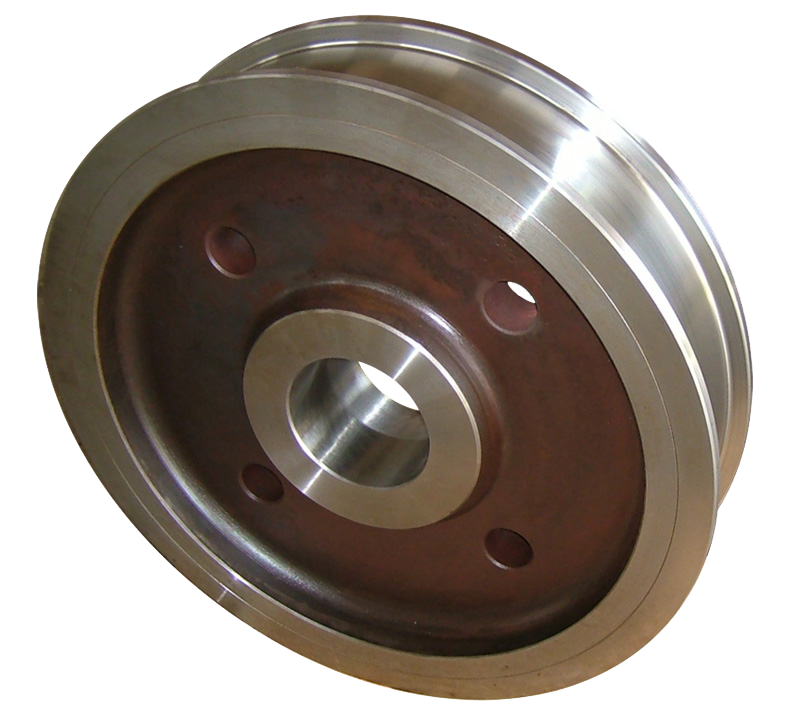
A forged crane wheel: single-piece body, machined tread and flange, hardened running surface.
Fatigue and Impact: Where the Gap Becomes Operational
Crane wheels rarely fail from a single overload. They fail from accumulated damage — repeated contact stress at the rail interface, shock loads at rail joints, and the load reversals of every travel cycle. Forged construction raises the stress threshold at which that damage begins, and published comparisons of the two manufacturing routes give a consistent picture.
| Property | Forged wheel | Cast wheel | What it changes on site |
|---|---|---|---|
| Fatigue life, heavy-duty service | Commonly reported at 2–3× the cast figure | Baseline | Replacement interval and planned outage frequency |
| Impact toughness at −20 °C | Around 40–80 J | Around 20–40 J | Winter start-up, rail joint shock, outdoor gantries |
| Tensile strength | Around 700–900 MPa | Around 550–750 MPa | Margin under occasional overload |
| Internal soundness | Porosity closed by deformation | Shrinkage porosity and segregation possible | Whether a subsurface defect can start a fatigue crack |
| Typical failure mode | Ductile — visible deformation before fracture | Can be sudden brittle fracture | Whether the maintenance team gets a warning |
| Relative unit price | Often 20–40% higher | Baseline | First cost only — not lifecycle cost |
The ranges above are indicative values cited in published forged-versus-cast comparisons and vary with grade, section size and heat treatment. For a specific project, ask for the material certificate and test report rather than relying on typical figures.
These are not laboratory curiosities. They are the properties that determine whether a ladle crane wheel survives a winter start-up, or whether a port gantry wheel absorbs a rail joint impact without initiating a crack. The failure-mode difference matters just as much to anyone responsible for safety: a forged crane wheel tends to fail in a ductile mode under overload, with visible deformation before fracture, while a cast wheel can fail by sudden brittle fracture with little or no warning. In a lifting application, that warning margin is a safety feature rather than a comfort.
Hardness Gradient and Wear: Holding the Profile Longer
Wear resistance at the tread and toughness in the core are competing requirements. A uniformly hard wheel becomes brittle; a uniformly soft wheel wears out of profile and begins to ride badly on the rail. The forging advantage is that it produces the structural uniformity required for a controlled hardness gradient to hold in service — not just to appear on the heat-treatment certificate.
Baoxin's standard specification for the 42CrMo forged crane wheel achieves HB300–380 at the tread and flange with an effective hardened depth exceeding 10 mm, leaving a tougher core to absorb shock loading. That combination is what allows the wheel to maintain its flange geometry and tread profile over a longer service interval, reducing the flange wear and tread spalling that drive premature replacement. Cast wheels can be surface hardened, but the as-cast microstructure varies across the section, so the hardened case is less consistent and the transition from hard case to soft core is less predictable.
The Cost Question: Unit Price vs. Cost per Operating Hour
A forged wheel typically carries a higher initial price than a cast wheel of the same envelope — often 20–40% more. That number is real and should be acknowledged. The relevant question is what it buys.
The cost case for forging is built on replacement interval, not unit price. A wheel that lasts twice as long removes half the replacement events from the maintenance calendar, and each event carries crane downtime, rigging labour, rail inspection and the risk of collateral damage during the change. In A6–A8 duty classes, where wheel replacement is already a planned activity, extending the interval can eliminate entire planned outages. Cast wheels remain cost-effective in A3–A5 service under roughly 20 tonnes, where loads are lighter and intervals are long enough that the forging premium is difficult to recover. In heavy-duty service the economics reverse: the forging premium is paid once, while the cast replacement cycle recurs.
Comparing a forging quote with a casting quote? Send the duty class and wheel envelope.
Get a QuoteWhich One Should You Specify?
The choice is not ideological. It is a function of duty class, load, and the consequence of failure.
| Duty class | Typical load | Usual choice | Reason |
|---|---|---|---|
| A3–A5 | Under ~20 t | Cast wheel | Long intervals and light loads make the forging premium hard to recover |
| A5–A6 transition | ~20–50 t | Case-by-case | Weigh downtime cost against the price difference |
| A6–A8 | Above ~50 t | Forged wheel | Fatigue margin and longer intervals; replacement already planned |
| Ladle and hot-metal cranes | Any | Forged wheel | Thermal load plus impact; brittle fracture is unacceptable |
| Outdoor gantry and port cranes | Any | Forged wheel | Low-temperature toughness and rail joint impact |
Procurement specifications for top-running bridge and gantry cranes frequently require forged or rolled steel wheels and exclude gray cast iron in loaded positions — the standard treats material construction as a safety variable, not a purchasing preference. Cast wheels remain appropriate for lighter-duty A3–A5 cranes under about 20 tonnes, low-cycle service, and cost-sensitive applications where the duty profile genuinely does not stress the fatigue limit of the material. The mistake is not choosing cast for light duty; the mistake is choosing cast for heavy duty and expecting forged performance.
42CrMo Forged Crane Wheel
OD 250–950 mm, tread HB300–380, hardened depth >10 mm.
View Product
Forging Crane Wheel
Single flange, double flange and flangeless configurations.
View Product
ASTM 1060 Jetty Port Wheel
Heavy port duty, forged in alloy steel to ASTM 1060.
View Product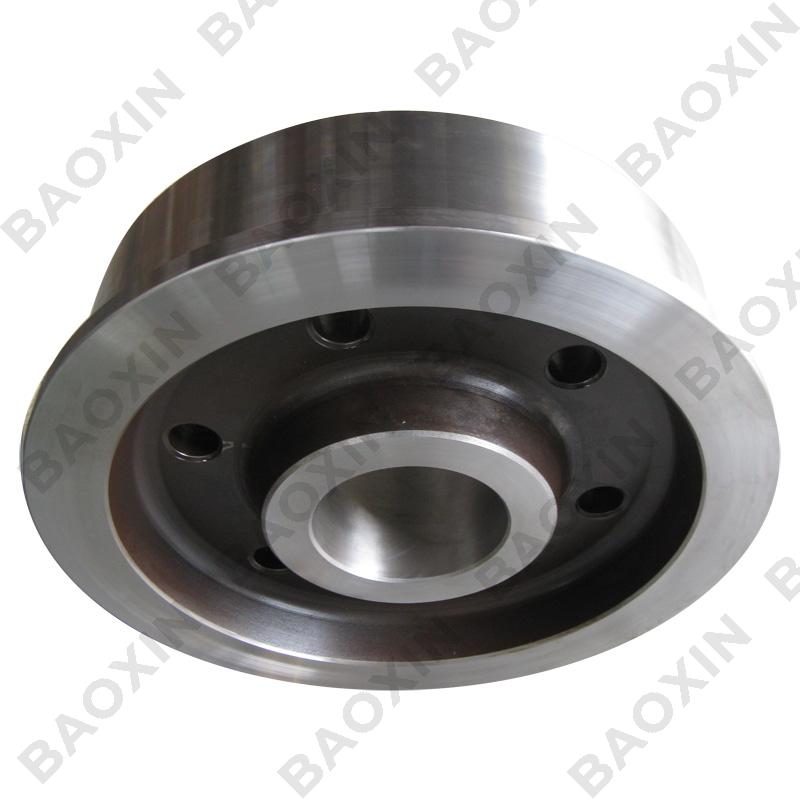
Bridge Crane Rail Wheel
OD 630 mm forged rail wheel for bridge crane travel drives.
View ProductVerifying the Wheel You Receive
Forging closes porosity; inspection is what confirms the process actually worked. Four items are worth writing into the purchase order, because each one is difficult to recover after delivery.
Ultrasonic and magnetic particle testing after heat treatment and before machining, with records traceable to the lot.
Hardness and case depth measured at the tread and flange, reported against the specified HB range and depth.
Envelope dimensions — tread diameter, flange profile, bore and hub width — checked against the crane drawings, since a forged wheel is a direct replacement only if these match.
Material grade certificate confirming the ordered grade, especially where 42CrMo or a low-temperature alloy is specified for outdoor service.
Need test records with the wheels? Baoxin supplies UT/MT reports and material certificates per lot.
Contact UsFAQ
Is a forged crane wheel always more expensive than a cast wheel?
Upfront, usually yes — commonly 20–40% more for the same envelope. Over the replacement interval, no: fewer changes, less downtime and fewer rail inspection events typically offset the premium in A6–A8 service.
Can I replace a cast wheel with a forged wheel on an existing crane?
Yes, provided the envelope dimensions match — tread diameter, flange profile, bore and hub width. The mounting interface does not change with the manufacturing method.
What material and hardness should I specify for heavy duty?
42CrMo is the common heavy-duty grade, specified at HB300–380 tread hardness with a hardened depth greater than 10 mm. Baoxin produces this specification as standard for steel rail gantry wheels from OD 250 mm to 950 mm, with 40CrNi2Mo, 65Mn and 60 available to customer request.
How do I know the wheel has no internal defects?
Require ultrasonic and magnetic particle inspection after heat treatment and before machining, with records traceable to the lot. Forging closes porosity; inspection verifies that the process worked.
What kills a forged wheel prematurely?
Most early failures trace back to specification or installation rather than the forging: inadequate case depth, rail misalignment producing flange overload, or an incorrect interference fit during mounting. A replacement wheel installed without correcting the root cause will repeat the failure.
The Decision in One Sentence
Choose the manufacturing method that matches the consequence of failure, not the line item on the purchase order. For light duty, cast can be adequate. For heavy duty, the forged crane wheel is the specification that buys back uptime — through internal soundness, fatigue margin, and a hardness gradient that holds its profile.
Baoxin manufactures forged crane wheels in 42CrMo and other alloy grades from OD 250 mm to 950 mm, with single-flange, double-flange and flangeless configurations for bridge, gantry and steel rail applications — the full range is listed on the crane wheel product page. If your current replacement interval is shorter than your planning cycle, the specification deserves a second look.



View More(Total0)Comment lists