


 sales@baoxincz.com

Top 5 Benefits of Forged Crane Wheels for Heavy-Duty Cranes
 Sep 11, 2026|
 View:2
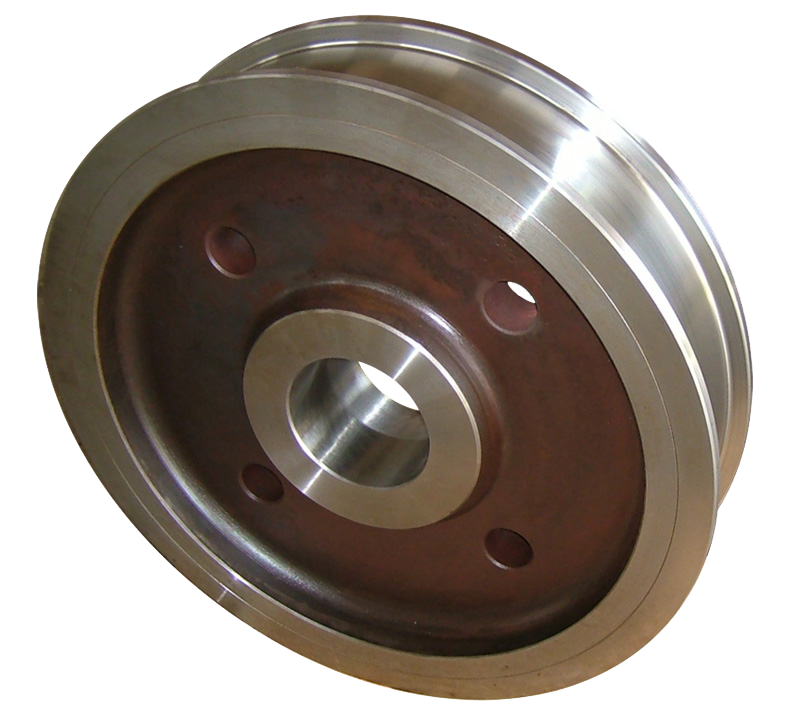
If your maintenance team replaces crane wheels on a calendar schedule instead of a condition-based one, the problem is usually not the schedule. It is the wheel specification. In heavy lifting, a forged crane wheel is often bought as a commodity—one line item among hundreds. That framing is expensive. The wrong wheel does not fail at the purchase order stage. It fails during a peak ladle cycle, a port shift change, or a weekend production run when no replacement is on the shelf. The five benefits below explain what a properly specified forged crane wheelactually changes in operating terms.
1. Internal Soundness You Cannot See—and Cannot Substitute
A forged crane wheel begins as a heated steel billet compressed under high force. Forging closes internal porosity and converts the coarse, random grain structure of the billet into a refined grain flow aligned with the wheel profile. The practical result is fewer internal discontinuities from which fatigue cracks can initiate in the tread and flange zones.
Casting solidifies from liquid. The last regions to freeze—typically the hub and rim center—are where shrinkage porosity and inclusion clusters concentrate. These features do not appear on a dimensional inspection. They surface later as subsurface fatigue origins under cyclic contact stress. For heavy-duty duty classes such as A6–A8, this is not an incremental quality difference. It is the difference between a wheel with a predictable fatigue life and one whose life is a distribution with a long, expensive tail. At Baoxin, every forged crane wheel lot is subjected to ultrasonic and magnetic particle testing after heat treatment and before machining, so internal soundness is verified as a process step.
2. Fatigue Life Under Cyclic Load: The Multiplier That Compounds
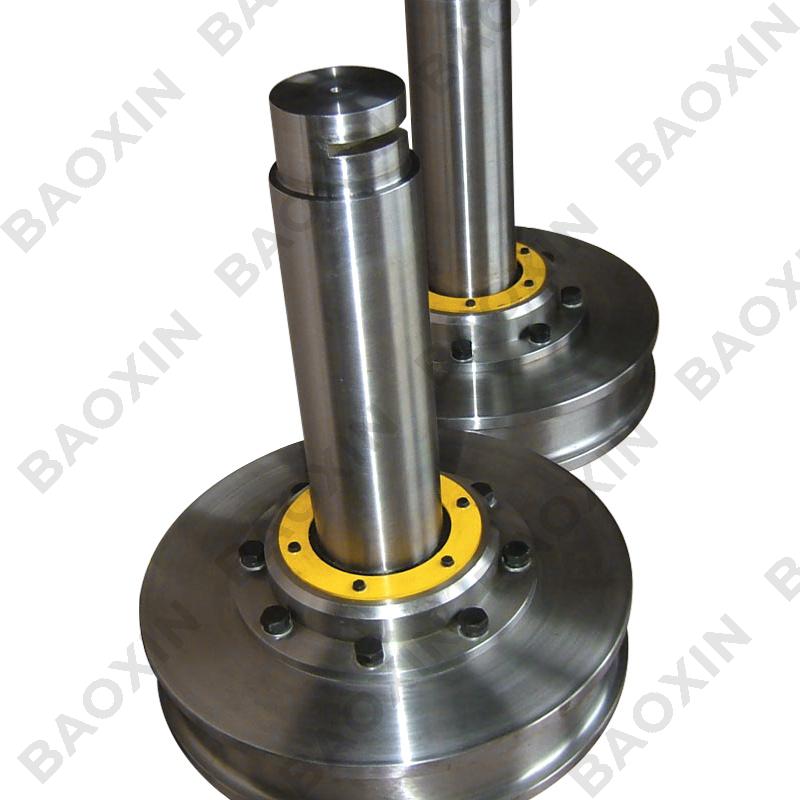
Crane wheels do not fail from a single overload in normal duty. They fail from accumulated contact stress, shock at rail joints, and the repeated load reversals of every travel cycle. Forged construction changes the fatigue equation at the metallurgical level: refined grain structure and closed internal voids raise the stress threshold at which fatigue damage begins.
The practical result is a service life commonly two to three times that of cast wheels in comparable heavy-duty service. This multiplier matters most where replacement is disruptive. Ladle crane wheels, outdoor gantry wheels exposed to low temperatures, and high-cycle bridge travel wheels all impose loading that punishes casting porosity. A forged crane wheel also tends to fail in a ductile mode under overload—visible deformation before fracture—where a cast wheel can fail by sudden brittle fracture with no advance warning. In a lifting application, that warning margin is a safety feature.
3. Hardness Gradient: Hard Tread and Tough Core in the Same Component
Wear resistance at the tread and toughness in the core are competing requirements. A uniformly hard wheel becomes brittle. A uniformly soft wheel wears out of profile. The forged crane wheel advantage is that forging produces the structural uniformity required for a controlled hardness gradient to hold in service, not just on the heat-treatment chart.
With 42CrMo alloy steel, Baoxin’s standard specification for heavy-duty forged crane wheels achieves tread and flange hardness of HB300–380 with an effective hardened depth greater than 10 mm. The core remains substantially tougher than the case, so the wheel absorbs shock loads without transferring the full impact energy into the hardened layer. Hardening is performed after forging and before final machining, and hardness and case depth are verified on the finished wheel. For severe duty, deeper cases and higher tread hardness can be specified to match the duty class and rail conditions.
4. Lifecycle Cost: The Invoice Price Is the Smallest Number
A forged crane wheel typically carries a higher initial price than a cast wheel of the same envelope. Procurement decisions that stop at that number systematically undervalue the operating math. The relevant figure is cost per operating hour, not cost per unit delivered.
The arithmetic is straightforward once downtime is included. A wheel that lasts twice as long reduces replacement events by half. Each replacement event carries crane downtime, rigging labor, rail inspection, and the risk of collateral damage during the change. In heavy-duty classes where wheel replacement is already a planned maintenance activity, doubling the interval removes entire planned outages from the annual calendar. The forging premium is paid once; the cast-wheel replacement cycle recurs. This is why the forged crane wheel cost case is strongest precisely where cast wheels appear cheapest per unit—high-cycle, high-load service where the replacement interval is short.
5. Safety Margin and Compliance: The Standard Is the Floor
Heavy-duty wheel specification is governed by frameworks that treat material construction as a safety variable. CMAA Specification No. 70 and ANSI/ASME B30.2 establish inspection and replacement expectations, and ISO 4301-1 classifies cranes by duty severity—with forged wheels preferred from A6 through A8 and for heavy-load applications above roughly 50 tonnes. A forged crane wheel provides margin against those requirements because its mechanical properties do not depend on the absence of casting defects. The wheel either has the internal soundness the forging reduction produces, or it does not pass inspection.
The safety dimension is practical. A wheel that holds flange geometry longer reduces derailment risk from misalignment and skewing. A wheel with documented ultrasonic and magnetic particle results gives the plant engineer evidence of internal integrity at acceptance, not at failure analysis. Baoxin’s forged crane wheels are supplied with material certification and inspection records traceable to the lot, which is the documentation maintenance and reliability teams need when an auditor or insurer asks how safety-critical components were verified.
FAQ: What Buyers and Maintenance Engineers Ask Most
Are forged crane wheels stronger than cast wheels in heavy-duty service? Yes—primarily in fatigue resistance and impact toughness, not just static strength. Forging eliminates internal porosity and refines grain flow, where cast wheels initiate cracks under cyclic loading.
What material is standard for a heavy-duty forged crane wheel? 42CrMo is the common specification for A6–A8 service. Baoxin also forges 40CrNi2Mo and 65Mn depending on the duty profile and customer specification.
How deep should the hardened layer be? For heavy-duty wheels, the case must be deep enough to support subsurface shear stresses. Baoxin’s standard heavy-duty specification calls for hardened depth greater than 10 mm at HB300–380, with deeper cases available on request.
Can a forged wheel be replaced one-for-one on an existing crane? Yes, if the envelope dimensions—tread diameter, flange profile, bore, and hub width—match the original. The manufacturing method does not change the mounting interface. Confirm duty class and hardness, not the bolt pattern.
Do forged wheels cost more upfront? Typically yes. The cost case is made over the replacement interval: fewer wheel changes, less crane downtime, and fewer rail inspection events over the service life.
What causes a forged crane wheel to wear prematurely? Most premature failures trace to specification or installation causes rather than forging itself: inadequate case depth, rail misalignment or tight gauge producing flange overload, or incorrect interference fit during mounting. A replacement wheel installed without correcting the root cause will reproduce the failure.
Specification Starts With the Duty Class, Not the Part Number
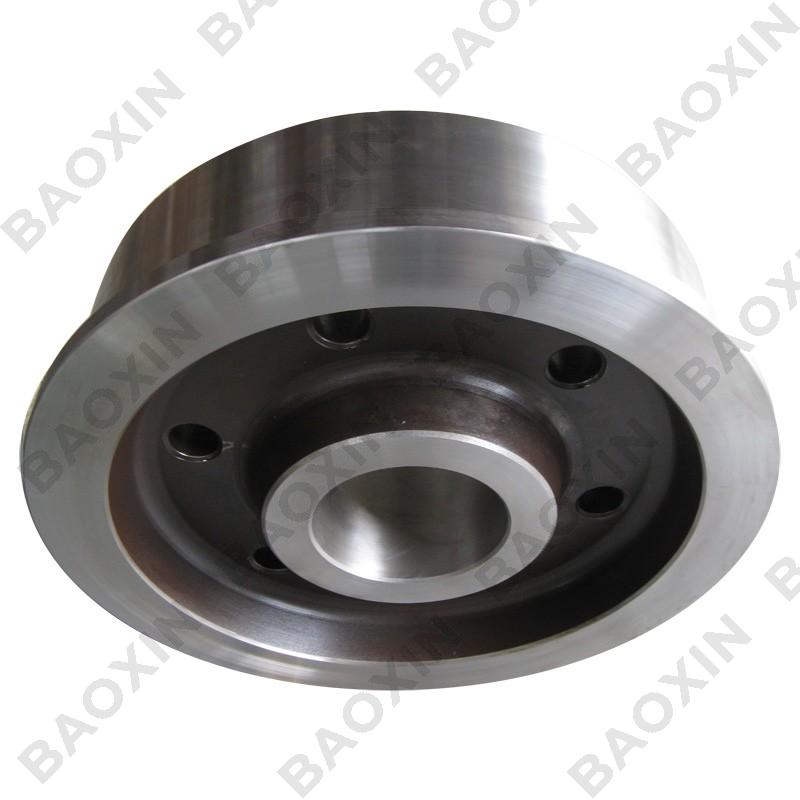
The five benefits converge on one principle: in heavy lifting, the wheel is a fatigue-rated structural component. The forged crane wheel advantage is cumulative—internal soundness supports fatigue resistance, fatigue resistance supports hardness-gradient performance, and hardness-gradient performance supports lifecycle cost and safety margin. At Baoxin, forged crane wheels from OD 250 mm to 950 mm are produced through controlled forging, quench-and-temper, and induction hardening, with single-flange, double-flange, and flangeless configurations available to match the end truck and rail system. If your current replacement interval is shorter than your planning cycle, the specification deserves a second look—and a forged wheel deserves the first quote.



View More(Total0)Comment lists