


 sales@baoxincz.com

What is sheave in wire rope?
 Oct 12, 2026|
 View:621
Wire rope rarely fails in the middle of a straight run. It fails where it bends — at the drum, or at the wheel that leads the rope into the load. That single fact explains why the wire rope sheave is treated as a wear-critical component rather than a passive guide, and why its diameter, groove profile and material end up in the purchase specification for every hoisting system.
Wire rope sheaves are among the most common mechanical components in lifting, transportation and mining equipment. Working together with wire rope, they carry out the lifting, traction and power transmission of materials. This article explains what a sheave is, how it influences rope life, how it is made, and what to put in a specification when ordering one.
Key Takeaways
A wire rope sheave is a grooved wheel that guides and supports a wire rope, redirects the line of pull and carries the rope load at the bend; steel is standard, with high-strength plastics on light-duty equipment.
Bending fatigue is one of the main causes of wire rope damage, and it accumulates at the sheave — sheave diameter relative to rope diameter is the strongest single lever on rope life.
Groove profile, hardness and surface finish control contact pressure: a groove that no longer matches the rope damages the rope long before the sheave fails.
Steel grade and manufacturing route — forged, hot-rolled and welded, or cast — set fatigue resistance and the achievable size range.
A quotation needs only a small set of inputs: rope diameter, working load, reeving, groove profile, bearing type and the operating environment.
What Is a Wire Rope Sheave?
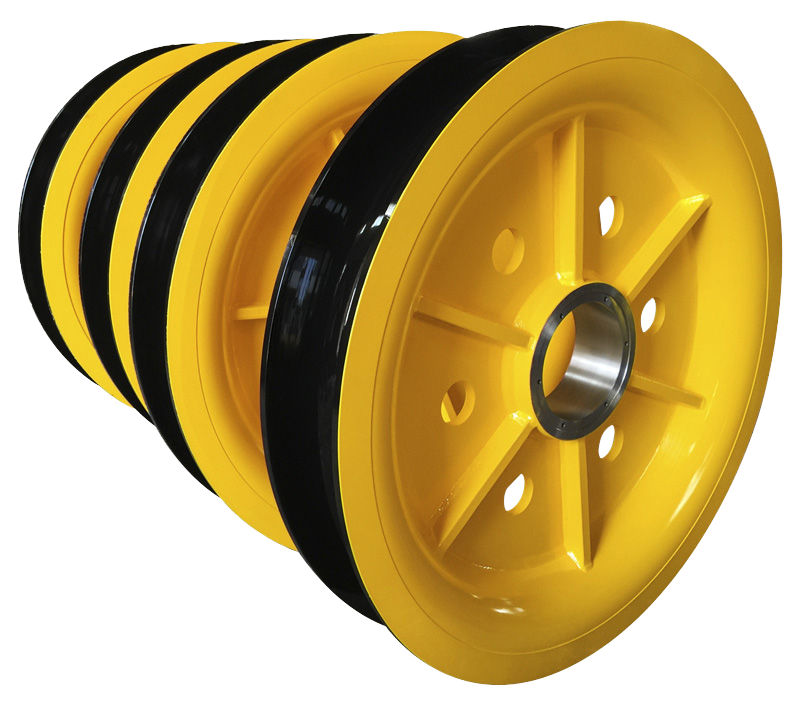
A sheave is a wheel used to guide and support the operation of a wire rope. It is usually made of metal — carbon or alloy steel — or of high-strength plastic on lighter equipment, and it carries a groove around its circumference that accommodates and guides the rope. Because the sheave gives the rope a controlled curved path instead of a sharp bend, it reduces friction and wear during operation and, in doing so, extends the service life of the rope.
In a working system the sheave performs three functions at once. It supports the rope and the load hanging from it, it changes the direction in which the rope can travel — from a horizontal drum to a vertical load, for example — and, where several sheaves are reeved together, it multiplies the force available at the load for a given line pull.

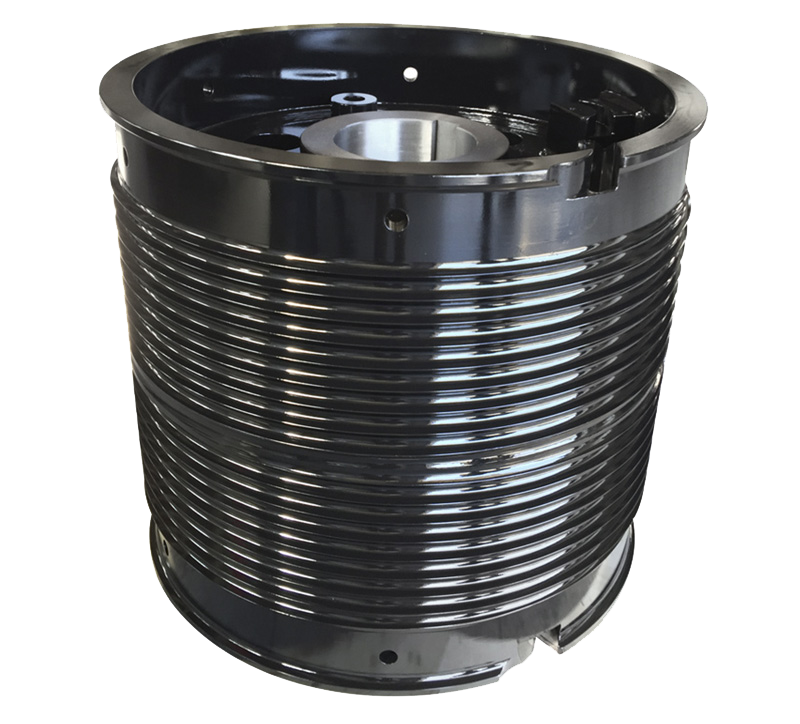
A wire rope sheave: the groove carries the rope, the hub carries the load.
The groove is the working surface
Everything that matters about a sheave happens in a few millimetres of groove. The profile is machined to suit the rope diameter and construction: too wide and the rope flattens, concentrating pressure on a few outer wires; too narrow and the rope is pinched and scrapes against the flanks. Production sheaves are usually grooved by CNC to the rope manufacturer's profile, then heat treated, then inspected — because the groove is the one feature that contacts the rope on every metre of travel.
Why the Sheave Decides Wire Rope Life
A sheave affects not only its own service life but the life, safety and efficiency of the whole system. Three mechanisms explain most of that influence.
Bending fatigue starts at the wheel
Each pass over a sheave bends the rope and then straightens it again. Individual wires see alternating bending and tensile stress, and after enough cycles broken wires appear on the outer strands — usually on the side that runs against the groove. Bending fatigue is one of the main reasons wire rope is taken out of service, which is why sheave geometry is treated as a rope-life decision rather than a structural one.
Sheave-to-rope diameter ratio
The larger the sheave in relation to the rope, the gentler the bend and the lower the bending stress in each wire. This ratio (D/d) is normally fixed by the crane or equipment designer from the applicable standard and the rope manufacturer's data; values of 20:1 or more are commonly specified for running ropes. Increasing sheave diameter improves rope life but adds weight, cost and space, so the ratio is a balance rather than a target to maximise.
Groove hardness, finish and contact pressure
A groove that has worn out of profile, corroded or picked up rope debris behaves like a file: it abrades the strands it is supposed to protect. Induction-hardened grooves resist this wear, and polishing the groove surface is reported to cut rope friction losses by up to 30% while extending rope service life. Hardness, hardened depth and surface finish are therefore specification items, not cosmetic details.
Matching a sheave to a rope that is already in service? Start with the rope diameter.
Get a QuoteMaterials, Manufacturing and Inspection
A sheave has to survive two different loads at once: the static load of the rope pressing into the groove, and the repeated bending that the wheel itself sees as it rotates under tension. Material selection addresses the first, manufacturing route addresses the second.
| Grade | Typical service | Why it is chosen |
|---|---|---|
| 45 (carbon steel) | General hoisting and traction sheaves | Widely available, responds well to induction hardening |
| Q345B | Hot-rolled and welded sheave plates | Good weldability for fabricated rims and webs |
| Q345D, Q345E | Cold-climate and outdoor equipment, down to −40 °C | Retains impact toughness at low temperature |
| 35CrMo, 42CrMo | High-load grooves and heavy-duty applications | Alloy steel for higher strength and hardness after heat treatment |
Material behaviour that matters in service
High-strength alloy steel is the usual choice for sheaves in continuous duty, because it combines fatigue resistance with the hardness needed at the groove. Good fatigue resistance lets the wheel absorb the repeated tension of the rope over long periods without cracking; high hardness keeps the groove surface intact under friction; wear resistance slows the loss of groove profile that eventually forces replacement. When one of these properties is under-specified, the failure shows up as accelerated rope wear rather than as a broken sheave — which is why material performance is usually judged from rope condition as much as from the wheel itself.
Forging, welding and the inspection chain
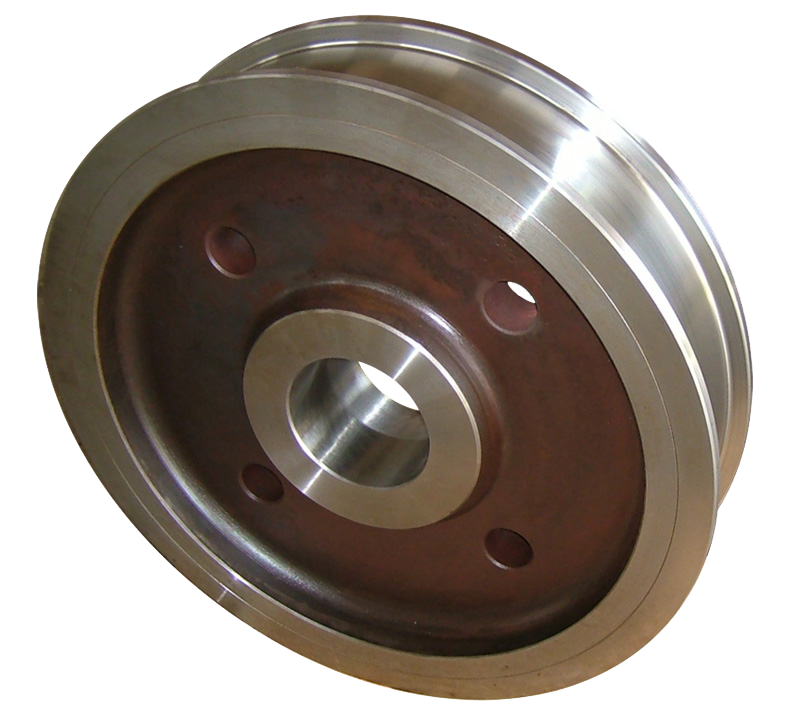
Forged sheaves are produced with controlled temperature and pressure, so the metal deforms plastically into a dense, uniform internal structure with a continuous grain flow around the rim. Hot-rolled and welded sheaves achieve similar diameters with lower tooling cost: the welding procedure is qualified in advance (a WPQR with supporting WPS, for example to AWD1.1), and weld lines are examined by magnetic particle and ultrasonic testing. Cast sheaves cover the largest diameters, where a single-piece casting is more economical than fabrication.
In all three routes, inspection runs from incoming material to finished part: material certificates, dimensional checks against the drawing, groove machining verification, magnetic particle testing of the groove after heat treatment, and a final visual check of the running surfaces. The result should be a sheave whose dimensional accuracy and test records can be checked against the specification — not merely one that looks correct on arrival.
| Parameter | Typical range or requirement |
|---|---|
| Outside diameter | Φ250 – 3000 mm |
| Rope compatibility | 3/8 in – 1/2 in on standard multi-groove designs, with round and flat groove profiles |
| Groove machining | CNC cut to the customer's rope profile |
| Groove hardness | Min. HB350–370 after induction quenching, hardened depth around ≥2.5 mm |
| Testing | Groove MT after heat treatment; weld MT and UT on welded sheaves |
| Bearing arrangement | Bearing assemblies Type A/B/C, bushing type D |
Wire Rope Sheave
Φ250–3000 mm, CNC groove, induction hardened, MT tested.
View Product
Hot Rolling Sheave
Welded sheaves with qualified WPS and weld MT/UT records.
View Product
Casting Sheave
Single-piece castings for the largest diameters.
View Product
Sheave Block
Assembled blocks for multi-fall reeving systems.
View ProductWhere Wire Rope Sheaves Are Used
Anywhere a rope has to be guided, pulled or redirected under load, a sheave is doing the work. The industries below account for most of the demand, and each one shifts the emphasis of the specification.
Lifting and hoisting equipment
Overhead cranes, gantry cranes, hoists and winches rely on sheaves to route rope from the drum to the hook block and to build mechanical advantage in the reeving. Duty is cyclic, so bending fatigue and groove wear set the maintenance interval.
Transportation and port machinery
Container cranes, ship unloaders and conveyor systems use sheaves in near-continuous operation. High cycle counts make groove condition the limiting factor, and replacements are planned around terminal schedules rather than left until failure.
Mining and heavy industry
Mining hoists, shaft equipment, steel mill continuous casting lines and shield machine drive systems work in dust, moisture and shock loading. Specifications here emphasise abrasion resistance, reliable inspection access and the cost of unplanned downtime.
Wind power and shipbuilding
Tower hoisting during wind turbine installation and heavy lifting in shipyards require precise rope guidance and predictable rope life in outdoor conditions — the reason low-temperature grades such as Q345D and Q345E appear in these specifications.
Specifying a Wire Rope Sheave
Sheaves are commonly made to order rather than selected from a catalogue, because the groove has to match the rope and the wheel has to fit an existing shaft and housing. A supplier can design and manufacture a sheave to a specific specification once the following inputs are known.
Rope: diameter, construction and lay, plus the manufacturer's recommended groove profile.
Geometry: required outside diameter or D/d ratio, groove pitch for multi-groove designs, and the shaft or bearing seat dimensions.
Load and duty: working load, number of rope falls, duty class and expected cycle count.
Environment: ambient temperature range, offshore or washdown exposure, dust and abrasion.
Documentation: material certificates, dimensional report and the non-destructive testing standard required.
These inputs are also the basis of the inspection plan, so agreeing them early avoids the usual problem of a sheave that fits the drawing but not the rope. For guidance on the examination intervals that apply after installation, the approved code of practice for safe use of lifting equipment and the inspection requirements for overhead and gantry cranes set out what a thorough examination should cover, while work equipment and machinery guidance covers the wider inspection regime.
Have a rope diameter, a drawing and a delivery date? Send them over.
Contact UsAbout the Manufacturer
Baoxin — Changzhou Baoxin Metallurgy Equipment Manufacturing Co., Ltd. — is based in Changzhou City, Jiangsu Province, and designs and manufactures spare parts for metallurgy equipment, hoisting machinery, oil drilling rigs and heavy-duty gearboxes. The company holds verification reports from DNV, is registered with Lloyd's Register and operates a certified quality management system. Its production range covers casting, hot-rolled and welded, ring-forged and solid-forged sheaves from Φ250 mm to Φ3000 mm, with dimensional reports, material certificates and NDT records supplied with each order.
Conclusion
Sheaves are the key to efficient and safe operation of wire rope systems: they guide the rope, carry its load at the bend, and determine how quickly bending fatigue accumulates. Choosing the right sheave diameter, groove profile and steel grade is therefore a rope-life decision as much as a component decision, and the inspection records that come with the part are as important as the part itself.
If you are looking for a dependable wire rope sheave manufacturer for lifting, port, mining or wind power equipment, Baoxin designs and produces sheaves to drawing, with the material and test documentation to match.
FAQ
What is the difference between a wire rope sheave and a pulley?
The two terms overlap. A pulley is the general mechanical arrangement — a wheel with a rope running in a groove — while a wire rope sheave refers specifically to the grooved wheel used in lifting, traction and hoisting systems. In crane and hoist practice, "sheave" describes the component and "pulley" is often reserved for belt drives and lighter transmission.
What material is a wire rope sheave made of?
Most production sheaves are carbon or low-alloy steel — 45, Q345B, Q345D or Q345E for general and low-temperature service, and 35CrMo or 42CrMo where higher strength is required. High-strength plastics are used on light-duty equipment. The groove is normally induction hardened to resist rope wear.
How does sheave diameter affect wire rope life?
A larger sheave bends the rope less sharply, which lowers bending stress in the individual wires and slows fatigue. The relationship is expressed as the sheave-to-rope diameter ratio (D/d); ratios of 20:1 or more are commonly specified for running ropes, with the exact figure set by the applicable standard and the rope manufacturer.
How often should sheaves be inspected?
Intervals are set by regulation, the equipment manufacturer's manual and the duty class. In practice this means frequent visual checks by the operator, plus periodic and thorough examinations at defined intervals. Groove wear, flange cracks, bearing play and rope condition are the items to record, because together they show whether the sheave or the rope is the limiting part.
Can sheaves be customised or re-grooved?
Yes on both counts, within limits. Sheaves are routinely made to a customer's drawing, rope profile and bearing arrangement. Re-grooving is possible on some designs, but only within the allowance set by the original manufacturer — removing too much material reduces the wall thickness that carries the rope load.





View More(Total0)Comment lists